I am proud to announce two of Trading Volatility's achievements for the first quarter of 2016. First, our indicators put in a rather impressive performance to kick off the year. We also launched automated trading for our VRP+VXX Bias and VXX Bias algorithms via Collective2's world-class platform.
First Quarter Indicator Results
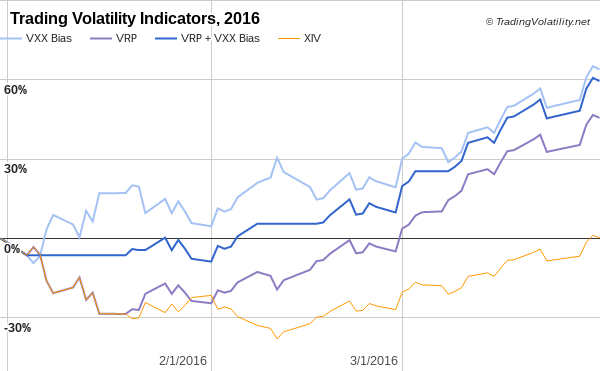
The Trading Volatility indicators had a bit of a slow start in the first month of 2016 but rallied strong off of February's market low. Our VRP+VXX Bias indicator finished at +59% for the first quarter of 2016, while our VXX Bias came in at +64%. Our VRP indicator finished the quarter at +46%.
Below is the first quarter equity curve for the Trading Volatility indicators versus XIV (buy and hold):
For those interested in additional details of the indicators, the daily history of indicator values that have been emailed to subscribers in 2016 can be found in the data sheet links below:
- VXX Bias: 2016
- VRP: 2016
- VRP+VXX Bias: 2016
Launch of Auto-Trading
While I'm happy about the performance over the first quarter I'm even happier about the new option of auto-trading our indicators on Collective2's platform. As I announced a couple months ago, you can now have trades automatically placed in your brokerage account whenever the VRP+VXX Bias indicator changes. Since that post, we have added auto-trading for the VXX Bias indicator as well. Both strategies are available on Collective2 at an 85% discount for active Trading Volatility+ subscribers.
I have previously written that the key to successful investing is to have a solid plan as well as the discipline to be able to execute against it. Having our indicators automated does exactly that.
No more worrying about missing trades because I'm too busy.
No more emotional barriers making me wonder if I'm making the right decision to buy or sell.
No more distractions from the noise of daily market movements.
No more being tied to a trading screen all day.
The indicators now execute against the plan automatically and actual trades are tracked on Collective2's site at the following pages: VRP+VXX Bias indicator & VXX Bias indicator
Nothing changes for the existing Trading Volatility+ service. Subscribers will continue to have access to our intraday indicator data, receive emails with preliminary and final change alerts for each of the indicators as well as our daily summaries, and interact with our private community of volatility traders in the forum. If interested, you can learn more about our services on our Subscribe page.
As always, each day's indicator values, buy/sell triggers, trade performance summary, and equity curves are tracked in the spreadsheets linked at the bottom of our Subscribe page. Additional information on our trading strategy and indicators can be found on our Strategy page.
------------
Hypothetical and Simulated Performance Disclaimer
The results are based on simulated or hypothetical performance results that have certain inherent limitations. Unlike the results shown in an actual performance record, these results do not represent actual trading. Also, because these trades have not actually been executed, these results may have under- or over-compensated for the impact, if any, of certain market factors, such as lack of liquidity. Simulated or hypothetical trading programs in general are also subject to the fact that they are designed with the benefit of hindsight. No representation is being made that any account will or is likely to achieve profits or losses similar to these being shown. Additional performance differences in backtests arise from the methodology of using the 4:00pm ET closing values for XIV, VXX, and ZIV as approximated trade prices for indicators that require VIX and VIX futures to settle at 4:15pm ET.
Our Indicator Performance: +59% In First Quarter Of 2016
By
Jay Wolberg
Posted on:
4/12/2016 11:06:00 AM
Automated Trading For Our VRP+VXX Bias Strategy
By
Jay Wolberg
Posted on:
2/16/2016 09:05:00 AM
By popular request, we have made it dramatically easier for people to trade our leading indicator, the VRP+VXX Bias.
Our VRP+VXX Bias strategy, which returned 36% in 2015, is now available for auto-trading using Collective2's world-class automatic trading platform.
One of the biggest problems for traders and investors is discipline in execution. Scheduling conflicts, emotional barriers, trading fatigue, and lack of confidence can all lead to a deviation from proper trading plan execution. Automation is key in eliminating these common trading pitfalls.
This link is the new home of the VRP+VXX Bias strategy on the Collective2 website where you can follow the trading record, statistics, and a description of the product.
Auto-Trade At An 85% Discount**
Subscribers to our Trading Volatility+ service will receive an 85% discount on the C2 auto-trading service for as long as you remain a Trading Volatility+ subscriber (contact us for a coupon code).
7-Day Free Trial
Sign up at Collective2 for a 7-day free trial with no commitment and see what you think!
More Information On Collective2's Auto-Trading Platform
Collective2's auto-trading platform allows you to have the trades in our strategy mirrored in your own brokerage account. You control the brokerage firm, the trade size, and the ability to intervene to take profits or place your own stops. See here for additional information on their auto-trading and the list of compatible brokers.
Details On Our Automated Trading Plan
The trading execution on the C2 platform utilizes automated buy and sell signals from our VRP+VXX Bias indicator. The following are the detailed mechanics of this automated trading system:
- Trades will be placed at 3:57pm ET if our indicators detect a change in direction.
- Since our VRP+VXX Bias values become official at 4:33pm ET, any discrepancies with the official signal will be resolved at the open of the next trading session.
- This strategy is in 100% cash approximately 30% of the time.
- This strategy typically makes 20-30 trades per year.
- All VXX trades are entered with a 6% stop loss.
- All XIV trades are entered with a 10% stop loss.
- Additional data on our VRP+VXX Bias strategy can be found on our Strategy page.
** Promotional discount offerings subject to change without notice.
Our VRP+VXX Bias strategy, which returned 36% in 2015, is now available for auto-trading using Collective2's world-class automatic trading platform.
One of the biggest problems for traders and investors is discipline in execution. Scheduling conflicts, emotional barriers, trading fatigue, and lack of confidence can all lead to a deviation from proper trading plan execution. Automation is key in eliminating these common trading pitfalls.
This link is the new home of the VRP+VXX Bias strategy on the Collective2 website where you can follow the trading record, statistics, and a description of the product.
Auto-Trade At An 85% Discount**
Subscribers to our Trading Volatility+ service will receive an 85% discount on the C2 auto-trading service for as long as you remain a Trading Volatility+ subscriber (contact us for a coupon code).
7-Day Free Trial
Sign up at Collective2 for a 7-day free trial with no commitment and see what you think!
More Information On Collective2's Auto-Trading Platform
Collective2's auto-trading platform allows you to have the trades in our strategy mirrored in your own brokerage account. You control the brokerage firm, the trade size, and the ability to intervene to take profits or place your own stops. See here for additional information on their auto-trading and the list of compatible brokers.
Details On Our Automated Trading Plan
The trading execution on the C2 platform utilizes automated buy and sell signals from our VRP+VXX Bias indicator. The following are the detailed mechanics of this automated trading system:
- Trades will be placed at 3:57pm ET if our indicators detect a change in direction.
- Since our VRP+VXX Bias values become official at 4:33pm ET, any discrepancies with the official signal will be resolved at the open of the next trading session.
- This strategy is in 100% cash approximately 30% of the time.
- This strategy typically makes 20-30 trades per year.
- All VXX trades are entered with a 6% stop loss.
- All XIV trades are entered with a 10% stop loss.
- Additional data on our VRP+VXX Bias strategy can be found on our Strategy page.
** Promotional discount offerings subject to change without notice.
Our 2015 Indicator Performance: +36%
By
Jay Wolberg
Posted on:
1/08/2016 03:21:00 PM
2015 was a difficult year in the investing world. As it turns out, one of the best performing assets last year was cash since most other asset classes lost money.
According to CNBC, 2015 was the hardest year to make money in 78 years. Investment legends struggled with David Einhorn's Greenlight Capital and Bill Ackman's Pershing Square fund both losing 20%, while average hedge fund performance did not breakeven. In the process, 31 hedge funds shut down during 2015.
It is against this backdrop that we highlight our own struggle in 2015: +36% for our primary indicator (the VRP+VXX Bias).
The end results were respectable, but getting there was anything but easy. The second half of the year was fairly stressful and a bit disappointing given that it was +77% in June. The 2015 equity curve for each of our indicators for trading XIV & VXX, along with XIV's performance, is shown in the following graph.
Drawdowns were painful with VXX Bias experiencing a 43% drawdown in August, fully recovering and hitting a new peak of +94% YTD on September 1st, only to be followed by a 40% drawdown in October. VRP+VXX Bias strategy also experienced a 40% drawdown in the second half of the year and was not able to recapture its +77% high from June before year end.
For the more experienced traders these drawdowns were rather unpleasant. For the uninitiated, the drawdowns were probably enough to make them call it quits. But in the end, it was another year of outperforming just about everything by a large margin with only a couple dozen trades.
In order to compare our results to other known volatility strategies I've included Volatility Made Simple's 2015 performance graph for 24 strategies, below. Only the VIX vs VXV strategy outperformed our VRP+VXX Bias in 2015, but that strategy's long-term performance remains comparatively poor and suffers from inconsistency (57.6% avg annual return, 0.93 Sharpe ratio, and 70.6% max drawdown).
ZIV Bias Indicator
At -2%, ZIV (the medium-term VIX Futures inverse fund) once again outperformed XIV, which came in at -17% for 2015. While the ZIV Bias indicator was successful in its goal of keeping traders in cash and out of August's major drawdown, it faltered a bit during the choppy trading at the very beginning and end of the year. Ultimately, the ZIV Bias indicator underperformed buy-and-hold this year with a -9%.
As always, each day's indicator values, buy/sell triggers, trade performance summary, and equity curves are tracked in the spreadsheets linked at the bottom of our Subscribe page. Additional information on our trading strategy and indicators can be found on our Strategy page.
Trading Volatility+ subscribers have the benefit of seeing our intraday indicator data, receiving emails with preliminary and final change alerts for each of the indicators as well as our daily summaries, and interacting with our private community of volatility traders in the forum. If interested, you can learn more about our services on our Subscribe page.
2016 is already shaping up to be another exciting year for Trading Volatility. We'd love to have you join us in taking on this difficult market!
------------
Hypothetical and Simulated Performance Disclaimer
The results are based on simulated or hypothetical performance results that have certain inherent limitations. Unlike the results shown in an actual performance record, these results do not represent actual trading. Also, because these trades have not actually been executed, these results may have under- or over-compensated for the impact, if any, of certain market factors, such as lack of liquidity. Simulated or hypothetical trading programs in general are also subject to the fact that they are designed with the benefit of hindsight. No representation is being made that any account will or is likely to achieve profits or losses similar to these being shown. Additional performance differences in backtests arise from the methodology of using the 4:00pm ET closing values for XIV, VXX, and ZIV as approximated trade prices for indicators that require VIX and VIX futures to settle at 4:15pm ET.
According to CNBC, 2015 was the hardest year to make money in 78 years. Investment legends struggled with David Einhorn's Greenlight Capital and Bill Ackman's Pershing Square fund both losing 20%, while average hedge fund performance did not breakeven. In the process, 31 hedge funds shut down during 2015.
It is against this backdrop that we highlight our own struggle in 2015: +36% for our primary indicator (the VRP+VXX Bias).
The end results were respectable, but getting there was anything but easy. The second half of the year was fairly stressful and a bit disappointing given that it was +77% in June. The 2015 equity curve for each of our indicators for trading XIV & VXX, along with XIV's performance, is shown in the following graph.
Drawdowns were painful with VXX Bias experiencing a 43% drawdown in August, fully recovering and hitting a new peak of +94% YTD on September 1st, only to be followed by a 40% drawdown in October. VRP+VXX Bias strategy also experienced a 40% drawdown in the second half of the year and was not able to recapture its +77% high from June before year end.
For the more experienced traders these drawdowns were rather unpleasant. For the uninitiated, the drawdowns were probably enough to make them call it quits. But in the end, it was another year of outperforming just about everything by a large margin with only a couple dozen trades.
In order to compare our results to other known volatility strategies I've included Volatility Made Simple's 2015 performance graph for 24 strategies, below. Only the VIX vs VXV strategy outperformed our VRP+VXX Bias in 2015, but that strategy's long-term performance remains comparatively poor and suffers from inconsistency (57.6% avg annual return, 0.93 Sharpe ratio, and 70.6% max drawdown).
ZIV Bias Indicator
At -2%, ZIV (the medium-term VIX Futures inverse fund) once again outperformed XIV, which came in at -17% for 2015. While the ZIV Bias indicator was successful in its goal of keeping traders in cash and out of August's major drawdown, it faltered a bit during the choppy trading at the very beginning and end of the year. Ultimately, the ZIV Bias indicator underperformed buy-and-hold this year with a -9%.
As always, each day's indicator values, buy/sell triggers, trade performance summary, and equity curves are tracked in the spreadsheets linked at the bottom of our Subscribe page. Additional information on our trading strategy and indicators can be found on our Strategy page.
Trading Volatility+ subscribers have the benefit of seeing our intraday indicator data, receiving emails with preliminary and final change alerts for each of the indicators as well as our daily summaries, and interacting with our private community of volatility traders in the forum. If interested, you can learn more about our services on our Subscribe page.
2016 is already shaping up to be another exciting year for Trading Volatility. We'd love to have you join us in taking on this difficult market!
Hypothetical and Simulated Performance Disclaimer
The results are based on simulated or hypothetical performance results that have certain inherent limitations. Unlike the results shown in an actual performance record, these results do not represent actual trading. Also, because these trades have not actually been executed, these results may have under- or over-compensated for the impact, if any, of certain market factors, such as lack of liquidity. Simulated or hypothetical trading programs in general are also subject to the fact that they are designed with the benefit of hindsight. No representation is being made that any account will or is likely to achieve profits or losses similar to these being shown. Additional performance differences in backtests arise from the methodology of using the 4:00pm ET closing values for XIV, VXX, and ZIV as approximated trade prices for indicators that require VIX and VIX futures to settle at 4:15pm ET.
2016 VIX Futures Expiration Days And Roll Period Lengths
By
Jay Wolberg
Posted on:
12/02/2015 08:35:00 AM
In preparation for trading VIX ETPs in 2016, I wanted to share the expiration date for all monthly VIX futures next year as well as the number of days in each roll period. Table below (source calendar).
Expiration Date Roll Period Length
- Ending January 20: 23 days
- Ending February 17: 19 days
- Ending March 16: 20 days
- Ending April 20: 24 days
- Ending May 18: 20 days
- Ending June 15: 19 days
- Ending July 20: 24 days
- Ending August 17: 20 days
- Ending September 21: 19 days
- Ending October 19: 20 days
- Ending November 16: 20 days
- Ending December 21: 24 days
Expiration Date Roll Period Length
- Ending January 20: 23 days
- Ending February 17: 19 days
- Ending March 16: 20 days
- Ending April 20: 24 days
- Ending May 18: 20 days
- Ending June 15: 19 days
- Ending July 20: 24 days
- Ending August 17: 20 days
- Ending September 21: 19 days
- Ending October 19: 20 days
- Ending November 16: 20 days
- Ending December 21: 24 days
The Most Important Chart For Trading Volatility ETPs
By
Jay Wolberg
Posted on:
12/01/2015 05:46:00 PM
On April 5, 2014 I wrote an article titled Shorting Volatility: Time To Reduce Profit Expectations for 2014 which outlined why I thought it would be difficult for XIV (the fund which tracks the inverse daily return of volatility futures) to finish positive for 2014. When the article was published XIV had returned an impressive +547% over the past 28 months, as shown in the chart below.
Understandably, many people disagreed with my view, yet XIV finished the 2014 year -9%.
Later in 2014 (September) I wrote The End of an Era for the Market, in which I discussed how a choppy market that is no longer a reliable environment for shorting volatility had become the norm as the Fed concluded their QE program. XIV lost 37% of its value over the next four months and is currently down 30% since that post.
If it wasn't already clear, XIV is not a buy and hold security. It has returned -20% over the past year and -7% over the past two years. The environment is not the same as what it was in 2012 and 2013.
How did I make these calls?
Because returns in XIV are heavily dependent on the Weekly Roll Yield (WRY).
A major factor for the lower returns in the past two years comes from a smaller weekly roll yield that is used to propel XIV. The inverse of the XIV WRY is the VXX WRY (which comes from the difference between first and second month VIX futures). We track this important metric on our site, and as you can see in the graph below, the roll yield has moved from -2% to -1% over the past several years and has recently started to move toward 0%.
This is most important graph because the WRY serves as a headwind or tailwind to VIX ETPs. As the WRY approaches zero, trends become less stable and our advantage in trading XIV or VXX diminishes. Conversely, as the WRY moves away from zero trends become stronger.
Right now there is less of a headwind for VXX and less of a tailwind for XIV/SVXY. At this point in our old bull market we are also at high risk for the VXX WRY turning positive, which would give VXX a tailwind and XIV a headwind.
Revisiting our graph which compares the annual returns of XIV to the average Weekly Roll Yield (below), we can see why the WRY is so important.
Looking at the trendline we can see that with a fairly constant 1% WRY, we can generally expect XIV to return ~+25% per year. As the average WRY moves towards 2% we can expect XIV to return ~+120% per year. At 0%, XIV is likely to return ~-60%. The recent shrinking of the WRY from 2% to 1% has an enormous impact on returns and that's why it is so important. A continued move of the WRY toward 0% or higher would be alarming to investors who plan to buy-and-hold XIV.
Because the WRY is such an important factor in the performance of VIX ETPs, our approach is to trade XIV and VXX using the WRY as a primary input for our VXX Bias and ZIV Bias indicators (our strategies are outlined here). While XIV is negative on the year, our VXX Bias indicator has put forth a performance of +33% YTD.
No credible trader will ever say that trading is easy, and that is doubly true when it comes to volatility. It requires a deep understanding of market forces, a solid process-oriented plan, and discipline in execution. In the current environment it will be more important than ever to stay on top of changing conditions.
We have been in the business of helping traders stay on top of the volatility market for three years now. We look forward to a fourth year of providing a variety of free data services throughout our website and are always happy to answer questions submitted through our Contact page. We also offer subscriber services to people looking for additional data, metrics, automated alerts and daily summaries, and access to a community of volatility traders. If you're interested, don't hesitate to drop us a line.
------------
Hypothetical and Simulated Performance Disclaimer
The results are based on simulated or hypothetical performance results that have certain inherent limitations. Unlike the results shown in an actual performance record, these results do not represent actual trading. Also, because these trades have not actually been executed, these results may have under- or over-compensated for the impact, if any, of certain market factors, such as lack of liquidity. Simulated or hypothetical trading programs in general are also subject to the fact that they are designed with the benefit of hindsight. No representation is being made that any account will or is likely to achieve profits or losses similar to these being shown. Additional performance differences in backtests arise from the methodology of using the 4:00pm ET closing values for XIV, VXX, and ZIV as approximated trade prices for indicators that require VIX and VIX futures to settle at 4:15pm ET.
Understandably, many people disagreed with my view, yet XIV finished the 2014 year -9%.
Later in 2014 (September) I wrote The End of an Era for the Market, in which I discussed how a choppy market that is no longer a reliable environment for shorting volatility had become the norm as the Fed concluded their QE program. XIV lost 37% of its value over the next four months and is currently down 30% since that post.
If it wasn't already clear, XIV is not a buy and hold security. It has returned -20% over the past year and -7% over the past two years. The environment is not the same as what it was in 2012 and 2013.
How did I make these calls?
Because returns in XIV are heavily dependent on the Weekly Roll Yield (WRY).
A major factor for the lower returns in the past two years comes from a smaller weekly roll yield that is used to propel XIV. The inverse of the XIV WRY is the VXX WRY (which comes from the difference between first and second month VIX futures). We track this important metric on our site, and as you can see in the graph below, the roll yield has moved from -2% to -1% over the past several years and has recently started to move toward 0%.
This is most important graph because the WRY serves as a headwind or tailwind to VIX ETPs. As the WRY approaches zero, trends become less stable and our advantage in trading XIV or VXX diminishes. Conversely, as the WRY moves away from zero trends become stronger.
Right now there is less of a headwind for VXX and less of a tailwind for XIV/SVXY. At this point in our old bull market we are also at high risk for the VXX WRY turning positive, which would give VXX a tailwind and XIV a headwind.
Revisiting our graph which compares the annual returns of XIV to the average Weekly Roll Yield (below), we can see why the WRY is so important.
Looking at the trendline we can see that with a fairly constant 1% WRY, we can generally expect XIV to return ~+25% per year. As the average WRY moves towards 2% we can expect XIV to return ~+120% per year. At 0%, XIV is likely to return ~-60%. The recent shrinking of the WRY from 2% to 1% has an enormous impact on returns and that's why it is so important. A continued move of the WRY toward 0% or higher would be alarming to investors who plan to buy-and-hold XIV.
Because the WRY is such an important factor in the performance of VIX ETPs, our approach is to trade XIV and VXX using the WRY as a primary input for our VXX Bias and ZIV Bias indicators (our strategies are outlined here). While XIV is negative on the year, our VXX Bias indicator has put forth a performance of +33% YTD.
No credible trader will ever say that trading is easy, and that is doubly true when it comes to volatility. It requires a deep understanding of market forces, a solid process-oriented plan, and discipline in execution. In the current environment it will be more important than ever to stay on top of changing conditions.
We have been in the business of helping traders stay on top of the volatility market for three years now. We look forward to a fourth year of providing a variety of free data services throughout our website and are always happy to answer questions submitted through our Contact page. We also offer subscriber services to people looking for additional data, metrics, automated alerts and daily summaries, and access to a community of volatility traders. If you're interested, don't hesitate to drop us a line.
------------
Hypothetical and Simulated Performance Disclaimer
The results are based on simulated or hypothetical performance results that have certain inherent limitations. Unlike the results shown in an actual performance record, these results do not represent actual trading. Also, because these trades have not actually been executed, these results may have under- or over-compensated for the impact, if any, of certain market factors, such as lack of liquidity. Simulated or hypothetical trading programs in general are also subject to the fact that they are designed with the benefit of hindsight. No representation is being made that any account will or is likely to achieve profits or losses similar to these being shown. Additional performance differences in backtests arise from the methodology of using the 4:00pm ET closing values for XIV, VXX, and ZIV as approximated trade prices for indicators that require VIX and VIX futures to settle at 4:15pm ET.
Subscribe to:
Posts (Atom)


